
Comparison guide · Weight
Metabolic Health vs Weight Loss: Why the Scale Is Not the Whole Story
Scale weight misses your true cellular health. Compare weight loss vs metabolic health, understand insulin resistance, and follow a 4-step action plan.
Quick Verdict
Have you spent weeks severely restricting your calories, stepping onto the scale every morning in frustration because the number won't budge—all while feeling exhausted, cold, irritable, and brain-fogged?
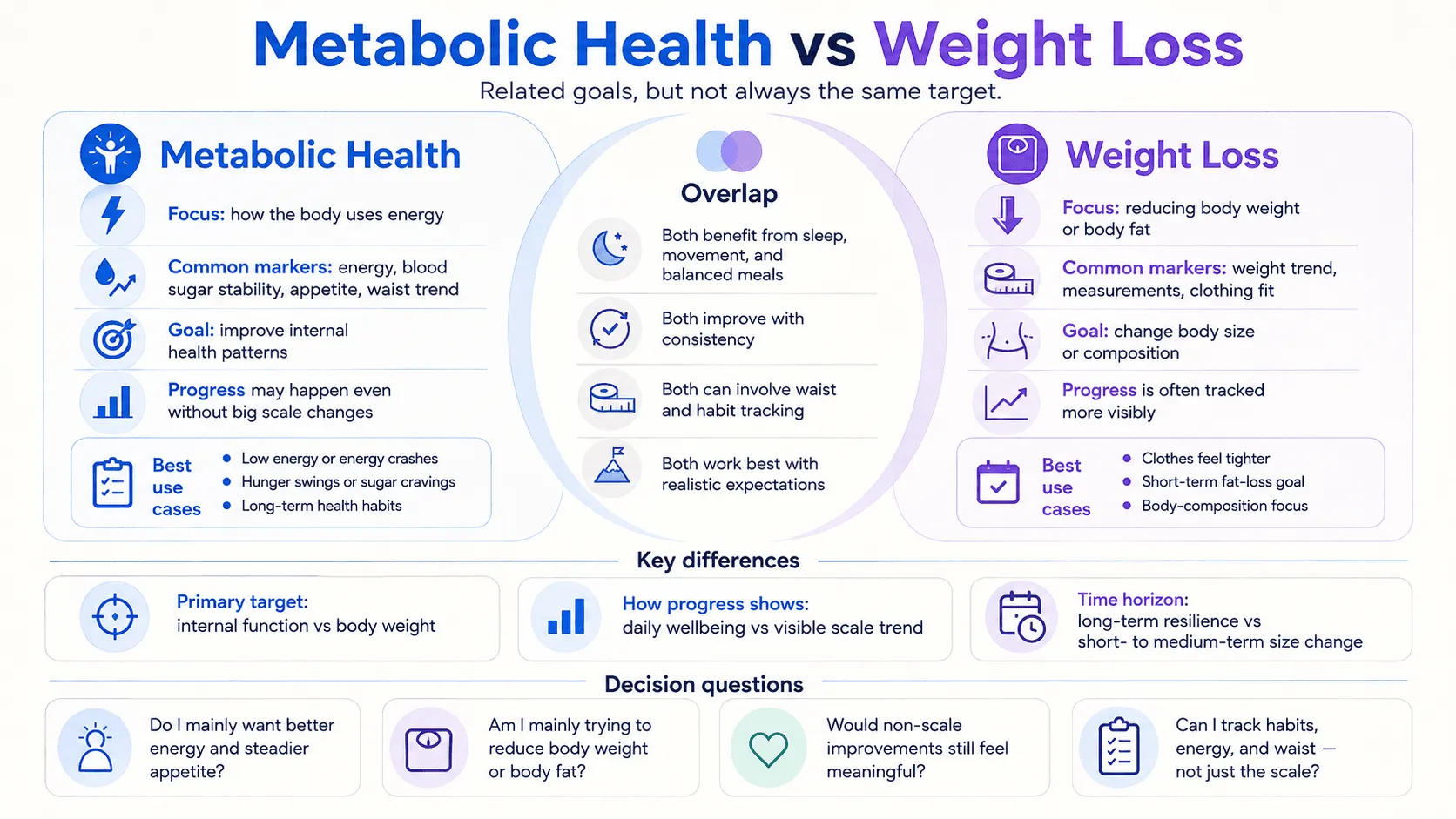
While culture treats them as identical goals, weight loss and metabolic health answer two completely different questions about your body:
- Weight Loss measures a reduction in total body mass—a bathroom scale cannot distinguish between loss of body fat, muscle tissue, water weight, or organ glycogen.
- Metabolic Health describes how efficiently your body generates, stores, and utilizes energy at a cellular level—evaluated through clinical markers like fasting blood glucose, HbA1c, blood pressure, lipid panels (triglycerides/HDL), insulin sensitivity, and liver health.
Pursuing aggressive weight loss through severe calorie deprivation often damages your metabolic health by burning lean muscle and slowing your resting metabolic rate. Conversely, optimizing your metabolic health improves energy, insulin sensitivity, and long-term fat balance without forcing you into chronic starvation.
Evidence and Decision Table
| Feature / Metric | Weight Loss (Body Mass Reduction) | Metabolic Health (Biochemical Function) |
|---|---|---|
| Primary Metric | Scale weight trend (Pounds or Kilograms) | Blood pressure, HbA1c, fasting glucose, triglycerides, HDL, liver enzymes, waist size |
| Real-World Metaphor | Car Body Weight & Cargo Load: Total physical weight recorded on a vehicle scale | Engine Efficiency & Battery Health: How cleanly the engine burns fuel without overheating or failing |
| Speed of Change | Rapid in early weeks (primarily fluid, water, and glycogen depletion) | Steady biochemical progression; blood markers reflect 8–12 week physiological cycles |
| Risk of Maladaptation | High; crash diets spark muscle wasting, metabolic slowdown, and intense hunger | Minimal; focusing on nutrient density, strength training, and sleep supports longevity |
| Independent Improvement | Losing weight can improve lipids and glucose, but scale loss alone guarantees nothing | Biomarkers (glucose, blood pressure, insulin) can improve dramatically before scale drops |
| Nutritional Focus | Caloric restriction and deficit creation | High protein, fiber, whole unrefined foods, blood sugar stabilization, cellular health |
Demystifying the Mechanics: Cargo Load vs. Engine Efficiency
To break free from scale obsession, understand the mechanical difference between total mass and metabolic machinery.
Weight Loss: Total Cargo Load
Imagine driving a delivery truck onto a commercial weighing station. The scale reads 6,000 pounds. If you drop off 500 pounds of valuable computer equipment (lean muscle tissue) or dump out the windshield washer fluid (water weight), the scale drops to 5,500 pounds. Weight loss simply records total mass drop. The vehicle scale does not care whether you lost dangerous visceral fat or vital metabolic engine parts.
Metabolic Health: Engine Efficiency and Fuel Processing
Metabolic health is about what happens under the hood. When you eat food, your digestive system breaks carbohydrates down into glucose. Your pancreas releases insulin—the cellular key that unlocks your muscle and liver cells so they can absorb glucose for energy. If your cells are insulin resistant (like rusted locks), glucose builds up in your bloodstream, forcing your body to pump out excessive insulin, store fat around organs (visceral fat), and elevate blood pressure. Improving metabolic health means oiling the locks, repairing cellular receptors, and restoring clean energy burning.
3 Common Myths Debunked
Myth 1: "If the scale number isn't dropping, your health isn't improving."
The Reality: Clinical studies consistently show that individuals who begin resistance training and eating a nutrient-dense diet can burn significant amounts of harmful visceral fat while building dense muscle tissue. Their scale weight may remain completely unchanged (or even increase slightly), yet their blood pressure drops, fasting insulin normalizes, and type 2 diabetes risk plunges.
Myth 2: "Drastic calorie cutting is the fastest way to restore metabolic health."
The Reality: Severe, prolonged calorie restriction triggers a protective biological response known as adaptive thermogenesis. Your thyroid downregulates, your basal metabolic rate (BMR) drops dramatically, ghrelin (hunger hormone) spikes, and your body begins breaking down lean muscle tissue for fuel. Starvation diets ruin metabolic flexibility.
Myth 3: "Being thin automatically guarantees perfect metabolic health."
The Reality: Up to 20% of normal-weight adults suffer from metabolically unhealthy normal weight (MUNW)—sometimes called "TOFI" (Thin Outside, Fat Inside). Despite a normal BMI and low scale weight, these individuals possess elevated visceral fat, silent insulin resistance, fatty liver disease, and high cardiovascular risk. Health is determined by cellular function, not aesthetic size.
4-Step Action Plan for Metabolic Vitality
Step 1: Benchmark Your Baseline Metabolic Markers
Evaluate your true physiological risk profile using objective body metrics and blood markers rather than scale weight alone.
- Action: Calculate your baseline risk with our BMI Calculator and discuss fasting glucose, HbA1c, and lipid panels with your physician.
Step 2: Overcome Cellular Energy Resistance
Understand why severe calorie restriction backfires and how cellular insulin resistance traps energy in fat storage.
- Action: Read Why Does My Body Resist Weight Loss? and discover the physiology behind plateauing in Why Cutting Calories Doesn’t Always Work.
Step 3: Shift Focus to Blood Sugar & Insulin Regulation
Prioritize strength training (muscle acts as a glucose sink) and protein-fiber meal structures to restore insulin sensitivity.
- Action: Follow our comprehensive guide to Improve Metabolic Health: A Practical Path Beyond Weight Loss and understand physical activity dynamics in Why Exercise Alone Isn’t Helping Me Lose Weight.
Step 4: Build Satiety-Driven Fat Loss Habits
Achieve sustainable body composition changes without triggering constant hunger, binge cycles, or metabolic adaptation.
- Action: Master long-term satiety with Lose Weight Without Constant Hunger.
Decision Snapshot
| Primary Objective | Focus Strategy | Key Target Metrics |
|---|---|---|
| Reversing Prediabetes / Fatty Liver | Metabolic Health Priority | Lower HbA1c (< 5.7%), lower fasting insulin, reduce waist circumference. |
| Preserving Muscle While Burning Fat | Body Composition Protocol | Adequate protein (1.6–2.2g/kg), heavy resistance training, moderate calorie deficit. |
| Ending Chronic Binge-Restrict Cycles | Metabolic Stabilization | Meal regularity, satiety signaling, eliminating extreme calorie cutting. |
| Managing High Blood Pressure / Lipids | Cardiometabolic Optimization | Whole food plant fiber, sodium balance, regular cardiovascular conditioning. |
Red-Flag Symptoms & Medical Safety Boundaries
Metabolic dysfunction (such as undiagnosed Type 2 Diabetes, severe hypertension, or thyroid failure) requires direct medical management.
Seek prompt medical evaluation if you experience red-flag symptoms:
- Unexplained, rapid weight loss despite eating normally (potential sign of Type 1 Diabetes onset or oncological concern)
- Extreme, unquenchable thirst (polydipsia) paired with frequent urination (polyuria)
- Persistent slow-healing sores, frequent infections, or blurred vision
- Severe dizziness, fainting, shortness of breath, or chest pain during daily activity
- History of active eating disorders or severe emotional distress related to body weighing
Medication Warning: If you take prescription medications for diabetes (such as insulin, sulfonylureas, or GLP-1 agonists) or blood pressure, making sudden dietary changes (like low-carbohydrate diets or fasting) can cause dangerous hypoglycemia or hypotension. Adjust medications only under direct physician supervision.
Medical Disclaimer
This comparison is for educational purposes only and does not constitute medical advice or treatment. Always consult a licensed physician or endocrinologist before starting new weight-loss regimens or making major dietary adjustments.
Sources
Related reading